Showing posts with label Modern Dance. Show all posts

Monday, October 1, 2007

Gigue


Gigue English dance distributed 16 century. The name comes from a word oldish French giguer (dance), or old English words giga (folk violin). First Gigue was size 4 / 4, and later became Gigue to invent in 6 / 8 with pointed eighth. At 17 and 18. Gigue (called in French-gigue) hit an instrumental suite and a finale in the sequence of the four major dance so. French Suites. Often such gigue sochinyalis in polyphonic format, with the second section was designed to, a topic of the first section.

Lindi dance

American dance, emerged between 1935 and 1940 and composed of jump up, run up and vibrate, in the form of pure improvisation of music style swing, especially Boogie-woogie. Regular rhythmical figure-solid eighth or transient pointed eighth and sixteenth. Development was lindi - hop, where six dancers feel when tetra-partite of music. A typical feature of the dance-partner rotation around the axis where the partner holding the hand of her back. Rhythm-emphasized syncopated with emphasis on the second and fourth share.

Monday, September 24, 2007

Galliard


As a dance, the galliard is improvised, with dancers combining together patterns of steps which occupy one or more measures of music. In one measure, a galliard typically has 5 steps; in French such a basic step is called a cinq pas and in Italy, "cinque passi". This is sometimes written in English sources as sinkapace. These steps are: right, left, right, left, cadence.

The galliard is an athletic dance, characterized by leaps, jumps, hops, and other similar figures. The main feature that defines a galliard step is that the last two beats consist of a large jump, landing with one leg ahead of the other. This jump is called a cadence, and the final landing is called the posture. The sources generally describe doing any pattern first starting on the left foot, and then repeating it starting on the right foot. A galliard pattern may also last twice as long, or more, which would involve 11 steps, or 17 steps, and so forth.

The galliard was a favorite dance of Queen Elizabeth I of England, and although it is quite a vigorous dance, in 1589 when the Queen was in her mid fifties, John Stanhope of the Privy Chamber reported, "the Queen is so well as I assure you, six or seven galliards in a morning, besides music and singing, is her ordinary exercise" (Alan Brissenden, Shakespeare and the Dance, pp 4-5).

In addition to being an entire dance, galliard steps are used within many other forms of dance. For example, 16th century Italian dances in Fabritio Caroso's and Negri's dance manuals often have a galliard section.

One special step used during a galliard is lavolta, a step which involves an intimate, close hold between a couple, with the woman being lifted into the air and the couple turning about 270 degrees, within one 6 beat measure. La Volta was considered quite a scandalous dance and some dancing masters questioned whether it ought to be danced at all.

Another special step used during a galliard is the tassle kick (Salti del Fiocco). These steps are found in Cesare Negri's manual, and involve a galliard step ending with a 180 degree or 360 degree spin, during which the dancer kicks out to kick a tassle suspended between knee and waist height.
Musical compositions in the galliard form appear to have been written and performed long after the dance fell out of popular use. In musical compositions, the galliard often filled the role of an after dance written in 6, which followed and mimicked another piece (sometimes a pavane) written in 4. The distinctive 6 beats to the phrase can still be heard today in songs such as "God Save the Queen".
http://en.wikipedia.org

Friday, September 7, 2007

Bergamaska

Bergamaska-dance 16-17 centuries. in 2/4 or 4/4, took place from the Italian city of Bergamo. Shakespeare mentions to bergamaska in comedy A Midsummer Night's Dream, so that the dance was known in England as early as in 1916. In manuscripts of the time bergamaska has a melody, which is often a basso ostinato (ie constantly recurring ABC), with variations. Melody bergamaska recalled later German folk song Kraut und RĂ¼ben that was used D. Buxtehude and then introduced I. S. Bach in his Goldberg- variations. Today, not associated with the old bergamaska, performed in a lively pace, at 6 / 8 and a reminder of tarantella, used Alfredo Piatti in Bergamaske for music.

Tuesday, September 4, 2007

Bass impedance

Bass impedance (Fr. basse danse "low-dance"). Bass-impedance generic name not jump sliding "dance" in 1916. ; The first time they appear in the university courtyard. "Low-dance" was "high contrast Dance" (danse haute), which are typical of high jumps and podprygivaniya. Bass impedance was a ceremonial dance, similar to Polonaise, ie associated with shaking more than with dance as such. Bass impedance is the predecessor stamps. Dance could run as in dicotyledons (usually), and trilobate amount. Bass impedance consists of three parts : the bass impedance, a repetition (retour de la danse basse) and Tordion-dance. Bass impedance faded 16. , A displaced afresh.

Saturday, August 25, 2007

Pop dance


Pop dance, dance spake stage, a small dance scene (dance miniatures), more entertainment. Built on short means dance expressiveness. Dance-pop origins in folk art, early forms of Soviet Russia in the statements dancer in Russian and gypsy chorus on popular galas (mid-19.) . Earlier in 1920. as performing arts genre emerged dance popular in the statements satirists and dancers, who started the tradition of the comedy numbers on the basis of folk (still in the contemporary pop and dance). Before the 1 st World War 1914-18 as performing artists were popular "salon" and "decadentstic" dances based on fashionable at the time Ballroom dancing (Tango, launch infuse etc.), more sophisticated elements acrobatic propes.

Friday, August 17, 2007

Ball dance

It is dance which serves for mass entertainment and it is executed by pair or a lot of participants on dancing evenings (balls). Ball dance often name also household dance. Process of differentiation of primitive, folklore dance on country, household (city and court) and scenic (ritual - temple, dance of the feudal nobility, national clowns) went simultaneously with development of a society and its social stratification on antagonistic classes. This process proceeded is similar in the countries Zap., West, The Europe, Asia and Africa. National sources. Have provided its viability and a wide circulation. They promoted becoming and creatively impregnated development of democratic genres and forms of household dance at various people.

Tuesday, July 17, 2007

Breakdance

Breakdance — the style of the street dance which has developed from hip-hop of movement in Southern Bronx (New York), in the beginning of 70th years. It is the oldest and most known of all styles hip-hop dances.
Breakdance is one of four components hip-hop alongside with a rap, DJ'Ingle and graffiti.

The popular belief is wide, that breakdance in its today's kind originates from a way of intermediary for finding-out of attitudes between competing gangs. However this opinion grows out gamble of mass-media during popularity of dance in 80. Even if dance also was the tool of intermediary productive intermediary was not neither the purpose, nor an outcome battles, often happened, that such battles on the contrary caused a new wave of violence.

Winners in performances became those who could execute as much as possible new and complex movements on execution which contenders could not repeat.
Owing to increase in popularity of a legend fank James Brown and to fast growth of quantity breakdance commands (such as Rock Steady Crew), breakdance from competition between gangs overgrown in a phenomenon the priest-culture. Owing to mass-media, breakdance it became known to general public. After a while any party, a disco or show of talents did not do without performance of dancers breakdance.

Thursday, July 5, 2007

Flamenco

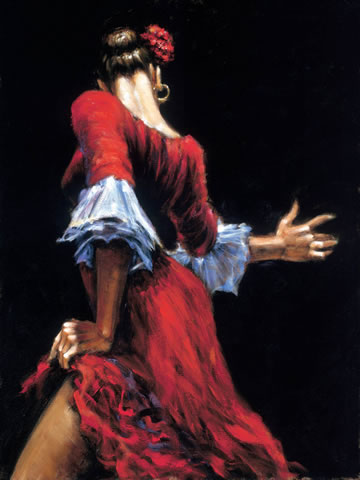
Flamenco (beauty of lines of a body) Improbable dance. Caused its war, religion, sufferings and love, unlike dances of set of other people, have not made its collective. Yes, is in it both eagerness to fight, and love melancholy and passion. But the dancer bears all this in itself. " Without the opponent to whom it is necessary to battle, without a beloved or the lover to whom the love is turned, executor flamenco is capable to express the feelings ". It, baylaor as if battles to itself - from here improbable expressiveness, force and passion of dance. Unlike other European dances where aspire to creation of illusion of freedom from forces of terrestrial gravitation, flamenco, with its wonderful movements by a foot, tries to keep communication of the dancer with the ground, and the most expressive movements of hands and legs always come back to the center of a body.
Until recently between executors flamenco - men and women - existed in dance a considerable difference. In man's - complex work of legs and the fast rhythmic images caused by knock of heels and a foot - sapateado was emphasized. Female remained softer - the main requirement: achievement of grace, beauty of lines of a body and a continuity of movement of hands. But today the difference between female and man's execution has practically disappeared.
This art was born on the ground of Andalusia, and many connect its origin with gipsies, which profits to Spain in the beginning of XV century. They have formed some kind of a musical caste, considered itself as descendants of the Egyptian pharaons, not recognizing the relationship with other gipsies, and is proud named itself «flamencos» … Clothes for employment For participation in this program better to prepare footwear on low (3-5 see) Wide heel, with a thin leather or plastic sole. At women traditionally for flamenco - skirt strongly flared from top to bottom (or a dress of a similar silhouette). It is important, that the skirt fitted a hip, emphasizing their movements during dance, and at the same time was enough wide below that you could "play" freely with it. Long hair or collect in high beautiful unit (the some it helps to experience an image), or leave dismissed (and then they add dynamism to your movements). The clothes of the top part of a body should fit a torso, but not hold down movement of hands. Men can put on jeans lessons, it is simple trousers and a shirt with a long sleeve which refuels in trousers. Footwear - classical boots on a leather or plastic sole or dancing shoes for the Latin American dances.
In what advantage of employment flamenco? Usually reason for employment flamenco seldom become practical reasons. People start to be engaged in this kind of dance because flamenco grasps the staginess, temperament, responds in a shower. Already then, during employment, you start to notice in yourselves pleasant changes. It and a beautiful bearing as during employment gradually necessary muscles become stronger, and graceful statement of the case becomes a habit, which always with you. It and a thin waist as in this dance "twistings" - movements when shoulders are developed rather hips are constantly used that the press which form a waist provides regular loading on slanting muscles. It and coordination as Flamenco combines various movements, from slowed down and smooth up to very fast, sharp. The rhythm varies, character of movements, and, hence, and your emotions varies. For one employment it is possible to test all scale of feelings and experiences: Through movement to splash out the collected pressure and aggression, internally to be cleared and be typed fresh energy, to feel revealing inside, as a flower, tenderness and love.

 
Blog Flux Directory