Showing posts with label Styles dance. Show all posts

Saturday, October 6, 2007

Quadrille


Quadrille is a historic dance performed by four couples in a square formation, a precursor to traditional square dancing. It is also a style of music. A derivative found in the Francophone Lesser Antilles is known in the local Creole as kwadril.

The beginning – horsemen

The term quadrille came to exist in the 17th Century, within military parades, where 4 horsemen and their horses performed special square shaped formations or figures. The word quadrille is probably derived from the Spanish word "cuadrillo" (diminutive Spanish, meaning four) and from the Latin "quadratus" (meaning square).

From paired horses to paired dancers

This performance became very popular, which led people to perform a quadrille without horses. In the 18th Century (estimated around 1740) the quadrille evolved more and more in an intricate dance, with its foundation in dances like cotillions. It was introduced in France around 1760, and later in England around 1808 by a woman known as Miss Berry. It was introduced to the Duke of Devonshire and made fashionable by 1813. In the following years it was taught to the upper classes, and around 1816 many people could dance a quadrille.

The quadrille (in French quadrille de contredanses) was now a lively dance with four couples, arranged in the shape of a square, with each couple facing the center of that square. One pair was called the head couple, the other pairs the side couples. A dance figure was often performed first by the head couple, and then repeated by the side couples. In the original French version only two couples were used, but two more couples were eventually added to form the sides of a square. The couples in each corner of the square took turns, in performing the dance, where one couple danced, and the other couples rested.

Terms used in the quadrille are mostly the same as those in ballet. Dance figures have names such as jeté, chassé, croisé, plié, arabesque, and so on...

Dances within Dances

As the quadrille became even more popular in the 19th century, it evolved into forms that used elements of the waltz, including Caledonian, Lancer, Ländler, Deutscher, and so on. When the quadrille became known in Germany and Austria, the dance composers from that time (Josef Lanner and the Strauss Family) also took part in the hysteria of the quadrille.

Where the music was new with every quadrille composed, the names of the five parts (or figures) remained the same. And if it were performed with dancers – audiences also preferred to listen to the dance alone, and not dance to it – the way of dancing to the parts remained (mostly) the same too. The parts were called:
Le Pantalon (a pair of trousers)
L’été (summer)
La Poule (hen)
La Pastourelle (shepherd girl)
Finale

All the parts were popular dances and songs from that time (19th century). Le Pantalon was a popular song, where the second and third part were popular dances. La Pastourelle was a well-known ballad by the cornet player Collinet. The finale was very lively.

Sometimes La Pastourelle was replaced by another figure, La Trénis. This was a figure made by the dance master Trenitz. In the Viennese version of the quadrille, both figures were used, where La Trénis (it was translated into French) became the fourth part, and La Pastourelle the fifth part, making a total of six parts for the Viennese quadrille.

Monday, October 1, 2007

Gigue


Gigue English dance distributed 16 century. The name comes from a word oldish French giguer (dance), or old English words giga (folk violin). First Gigue was size 4 / 4, and later became Gigue to invent in 6 / 8 with pointed eighth. At 17 and 18. Gigue (called in French-gigue) hit an instrumental suite and a finale in the sequence of the four major dance so. French Suites. Often such gigue sochinyalis in polyphonic format, with the second section was designed to, a topic of the first section.

Lindi dance

American dance, emerged between 1935 and 1940 and composed of jump up, run up and vibrate, in the form of pure improvisation of music style swing, especially Boogie-woogie. Regular rhythmical figure-solid eighth or transient pointed eighth and sixteenth. Development was lindi - hop, where six dancers feel when tetra-partite of music. A typical feature of the dance-partner rotation around the axis where the partner holding the hand of her back. Rhythm-emphasized syncopated with emphasis on the second and fourth share.

Monday, September 24, 2007

Galliard


As a dance, the galliard is improvised, with dancers combining together patterns of steps which occupy one or more measures of music. In one measure, a galliard typically has 5 steps; in French such a basic step is called a cinq pas and in Italy, "cinque passi". This is sometimes written in English sources as sinkapace. These steps are: right, left, right, left, cadence.

The galliard is an athletic dance, characterized by leaps, jumps, hops, and other similar figures. The main feature that defines a galliard step is that the last two beats consist of a large jump, landing with one leg ahead of the other. This jump is called a cadence, and the final landing is called the posture. The sources generally describe doing any pattern first starting on the left foot, and then repeating it starting on the right foot. A galliard pattern may also last twice as long, or more, which would involve 11 steps, or 17 steps, and so forth.

The galliard was a favorite dance of Queen Elizabeth I of England, and although it is quite a vigorous dance, in 1589 when the Queen was in her mid fifties, John Stanhope of the Privy Chamber reported, "the Queen is so well as I assure you, six or seven galliards in a morning, besides music and singing, is her ordinary exercise" (Alan Brissenden, Shakespeare and the Dance, pp 4-5).

In addition to being an entire dance, galliard steps are used within many other forms of dance. For example, 16th century Italian dances in Fabritio Caroso's and Negri's dance manuals often have a galliard section.

One special step used during a galliard is lavolta, a step which involves an intimate, close hold between a couple, with the woman being lifted into the air and the couple turning about 270 degrees, within one 6 beat measure. La Volta was considered quite a scandalous dance and some dancing masters questioned whether it ought to be danced at all.

Another special step used during a galliard is the tassle kick (Salti del Fiocco). These steps are found in Cesare Negri's manual, and involve a galliard step ending with a 180 degree or 360 degree spin, during which the dancer kicks out to kick a tassle suspended between knee and waist height.
Musical compositions in the galliard form appear to have been written and performed long after the dance fell out of popular use. In musical compositions, the galliard often filled the role of an after dance written in 6, which followed and mimicked another piece (sometimes a pavane) written in 4. The distinctive 6 beats to the phrase can still be heard today in songs such as "God Save the Queen".
http://en.wikipedia.org

Wednesday, September 19, 2007

gallop

Gallop, from French galoper-track ". Quick circular dance in 1919. in dicotyledonous amount consists of a rapid FSE movements back and forth dance floor anthem, similar to the type credited. Since 1825 gallop entered the fashion in Germany, where he called rucher or hyupfer. Gallop is fairly common in professional music; Example Big much gallop F. List.

Gavot-dance

Gavot-dance in a calm pace, three partite rate charges (of Provençal word gavoto-resident "of Auvergne"). Classic French and joyful dance 16-18 centuries. , be fulfilled in a moderate lap dance pace. Size 2/2 or 4/4, beginning with 2/4 and 2/8. Gavot consists of two parts on 8 tacts. Originally a part branle. In 17. round was dancing in 18. become a pair dance with different figures. Gavot popularity has J.-B. Lyulli. Gavot occurs in Kuperena Suites, and especially Pahelbely I. S. Bach. So you think you can dance? Yes!

Wednesday, September 12, 2007

Boorre dance

Boorre - century French dance 17-18s , Rising to pantomimics folk dance of Auvergne and 17s become courtier dance. To dance typical dactylic meter rapid pace, the amount of dicotyledonous for bar two eighths. Boorre dance appears in the ballet Lyulli and Shmeltsera and instrumental Suites, for example I. S. Bach. Boorre dance found in the writings G. F. Handel, Philip Detusha, Andre Campra, K. Sen-Sans, E. Shabrie (Fantastic hospital) and others.

Branl dance

Branl-generic name for the dance 16-17 centuries. Their options were be branl in different provinces of France, Burgundy, Poitou, Champagne, Picardie, Lorraine, Obarua, Brittany. In 15. branl complete bass dance, in the 16-17 century. a separate dance, the variety which united in Suites. Order parts branl - suite following: branl double branl simple branl fun, and gavotte montirande; How can vary, but gavotte always at the end. Branl often included in the ballet Baroque, even when dance is already out of household items.

Friday, September 7, 2007

Bolero

Bolero - Spanish national dance, presumably invented approx. 1780 Sebastian Cerezo of Cadiz. In the folk-dance version of the Bolero for solo couples in a public performance of several couples can participate. Tradition required bone or guitar, if dance melody sung. Bolero has dicotyledonous, occasionally trilobate meter; Dance consists of five parts: pazeo, traversiya, diferensiya, traversiya and finals. Such samples Bolero professional music can be pure Bolero (or. 19), F. Chopin and orchestra Bolero M. Ravel. For Beethoven's Bolero is a solo, and K. M. von Weber included Bolero in his music to play Pretsioza. Ground Bolero can be found in the operas of the Blind Toledo Etienne Megyulya, Black dominoes, Nemoy of Portichi D. Ober, and the opera G. Berlioz Benvenuto Cellini. Fast version of Bolero is seguidilla (perhaps that it forms the basis for Bolero). Cuban Bolero and similar to the Dominican Bolero are dicots sinkopami with rhythm and form a Spanish version of the American Dance

Bergamaska

Bergamaska-dance 16-17 centuries. in 2/4 or 4/4, took place from the Italian city of Bergamo. Shakespeare mentions to bergamaska in comedy A Midsummer Night's Dream, so that the dance was known in England as early as in 1916. In manuscripts of the time bergamaska has a melody, which is often a basso ostinato (ie constantly recurring ABC), with variations. Melody bergamaska recalled later German folk song Kraut und Rüben that was used D. Buxtehude and then introduced I. S. Bach in his Goldberg- variations. Today, not associated with the old bergamaska, performed in a lively pace, at 6 / 8 and a reminder of tarantella, used Alfredo Piatti in Bergamaske for music.

Tuesday, September 4, 2007

Bass impedance

Bass impedance (Fr. basse danse "low-dance"). Bass-impedance generic name not jump sliding "dance" in 1916. ; The first time they appear in the university courtyard. "Low-dance" was "high contrast Dance" (danse haute), which are typical of high jumps and podprygivaniya. Bass impedance was a ceremonial dance, similar to Polonaise, ie associated with shaking more than with dance as such. Bass impedance is the predecessor stamps. Dance could run as in dicotyledons (usually), and trilobate amount. Bass impedance consists of three parts : the bass impedance, a repetition (retour de la danse basse) and Tordion-dance. Bass impedance faded 16. , A displaced afresh.

Tuesday, August 28, 2007

Allemande

Allemande - fr. allemand – "German". Dance 16–18 centuries as follows from its name – a German origin. Similarly to pavan, allemande represents dance in the moderate rate and bipartite the size. This quiet dance usually followed recovered trilobate grinder. In claviern 18 century allemande cost to a suite on the first place; for it follow grinder, a saraband and jig. In the end 18 century allemande « German dance » at a rate of 3/4 or 3/8 – the predecessor of a waltz referred to. The general instructions: as a whole dance reminds moving figures to a musical casket. A maximum of grace, ease and lightness. The gentleman sets a direction of change of figures. Lady follows submission of the gentleman, but thus it cannot be absolutely passive – its problem easily to react to changes of a direction of movement, keeping grace of a porcelain figurine. Sharpness and "clumsiness" of movements are absolutely excluded.

Saturday, August 25, 2007

Pop dance


Pop dance, dance spake stage, a small dance scene (dance miniatures), more entertainment. Built on short means dance expressiveness. Dance-pop origins in folk art, early forms of Soviet Russia in the statements dancer in Russian and gypsy chorus on popular galas (mid-19.) . Earlier in 1920. as performing arts genre emerged dance popular in the statements satirists and dancers, who started the tradition of the comedy numbers on the basis of folk (still in the contemporary pop and dance). Before the 1 st World War 1914-18 as performing artists were popular "salon" and "decadentstic" dances based on fashionable at the time Ballroom dancing (Tango, launch infuse etc.), more sophisticated elements acrobatic propes.

Friday, August 17, 2007

Ball dance

It is dance which serves for mass entertainment and it is executed by pair or a lot of participants on dancing evenings (balls). Ball dance often name also household dance. Process of differentiation of primitive, folklore dance on country, household (city and court) and scenic (ritual - temple, dance of the feudal nobility, national clowns) went simultaneously with development of a society and its social stratification on antagonistic classes. This process proceeded is similar in the countries Zap., West, The Europe, Asia and Africa. National sources. Have provided its viability and a wide circulation. They promoted becoming and creatively impregnated development of democratic genres and forms of household dance at various people.

Monday, August 13, 2007

Duende an edging of flamenco

Flamenco, an edging of flamenco, an edging hondo.

Edging hondo (cante jondo) is the most ancient kernel of flamenco, its fundamental principle. " The essence of difference an edging хондо from an edging of flamenco consists that an edging hondo goes back to the most ancient musical systems of India, prototypes singing, and flamenco, it later an echo, is certain and has finally developed in the eighteenth century. An edging hondo - mysterious reflection, an edging of flamenco - art feelings almost modern and strongly conceding on depth. Spiritual colour and local colour - here in what their radical difference ". (Federiko Garcia Lorca) the Edging hondo is the most universal and ancient voice Andalusia. A voice which is capable to express both personal tragedy, and a drama of whole people.

" Cante jondo " it is translated as "deep", "deep" singing. As well as specifies a word, an edging hondo is something so deep and ancient, that existed already in those days when all andalusits, gipsy and that we name flamenco, only arose, and, perhaps, also did not exist.

Fuller name of flamenco is " an edging of flamenco " (cante flamenco). In spite of the fact that in a literal translation from Spanish "cante" means "singing", this name includes both singing, and dances, and game on a guitar and covers all private displays of style of flamenco.

Dance of flamenco - features and suits

Characteristic feature of dance of flamenco traditionally considers "sapateado" - beat time a rhythm heels, a rhythmical drum-type sound of impacts by a heel and a sole of a boot on a floor. Nevertheless, in the beginning of existence of dance of flamenco sapateado it was executed only by dancers-men. As such technics of execution demands expenses of considerable physical strength, sapateado long associated with courage. For female dance smooth movements of hands, wrists and shoulders were more characteristic.

Now distinction between female and man's dance not so is bright, though movements of hands, flexibility and smoothness still distinguish dance of the woman. Movements of hands of the dancer wavy, "caressing" and even sensual. Lines of hands soft, neither elbows nor shoulders do not break a smooth bend. Even it is difficult to believe how much smoothness and flexibility of lines of hands subconsciously influences the general perception of dance bailaors. Movements of brushes extraordinary mobile, compare them to a revealing and closed fan. More geometric, constrained and strict, them it is possible to compare movements of hands of the dancer-man " to two swords cutting air " more likely.

Besides sapateado dancers use "peetos" (snap fingers), "palmas" (rhythmical claps the crossed palms) which often sound in beat, twice exceeding the basic rhythm of a song. In traditional flamenco of a hand should not be borrowed by any subjects and should be free for movements during dance. Considered traditional castanets all over again were used only in the Spanish classical dance and traditional andalussian the dances executed at once by several dancers. Nevertheless, because of approval of an audience now castanets - an integral part of any " show of flamenco ".

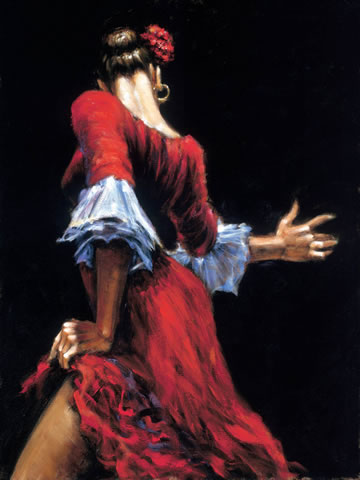
The important element of an image bailaor - the traditional dress named " bata de cola " - the dress typical for flamenco, is usual up to a floor, is frequent from a multi-coloured material in a peas, decorated by frills and flounces. A prototype of this dress became a traditional attire Gipsy. The Integral part of dance is graceful game with a hem of a dress.

Traditional clothes of the dancer-man - dark trousers, a wide belt and a white shirt with wide sleeves. Sometimes edges of a shirt are fastened in front on a belt. The short vest-bolero named chaleco, is sometimes put on atop of a shirt. When the woman executes the dance, traditionally considered man's, - sapateado or farruk, - it also dresses such suit.

Duande - Mystical Spirit Flamenco

Duande is soul of execution of flamenco without which this art becomes impossible. This word of the Spanish origin, literally it is translated as "spirit", "invisible being", "house", but with reference to art it has got other sense, and could be translated, more likely, as "feeling", "fire" or "magic". At us speak " In it there is no fire ", in Spain " No tiene duende ".

Actors of flamenco well know, that their art will not reach soul if in it there is no this fire. The one who saw true flamenco, never will confuse it with a fake. The executor should be inspired, should have a special condition of soul, on its emotional condition depends, whether the song of soul of listeners will reach. Besides flamenco - improvisation a genre, and without inspiration improvisation is impossible. For this reason in many records made in studio, this "feeling" for it cannot be repeated or imitationly is lost. One kantaor flamenco Jose de los Reyes El Negro spoke that it is necessary to feel the moment when will be possible to sing in the best way, giving a song the best part of. It has somehow admitted, that being in studio during record of the album, could not " enter into a situation " in any way so, could not sing " in the pleasure " only for the reason that it have warned: " When the red bulb will light up, start to sing! " Another prominent kantaor " old school " Antonio Majrena, spoke, that its records " no valen na " - cost nothing, because it " morning records ", and the especial inspiration to it came only at night.

Great kantaor Manuel Torres has somehow told to one singer: " you have a voice, you are able to sing, but you will reach nothing, because at you are not present duende. "

If an edging of flamenco is expression of that it is possible to feel, but it is impossible to explain, duande is that force which helps to inform this art up to listeners. This concept can concern not only to flamenco, but also to any other art. Goethe so has defined duande, speaking about Paganini: " Mysterious force which everyone feel also any philosopher will not explain. " Spanish poet Federiko Garcia Lorca creates the whole theory duande, personifying it and allocating with demonic features. It speaks, that duande is possible in any art, but " to it is more spacious in music, dance and oral poetry for which the embodiment in an alive human body is necessary. "

The concept "duande" long since existed in Spain. Duande is a demon which transforms a song into magic, and dance in shamanism. It is soul of flamenco without which it does not exist. Lorca speaks, that the Spanish art " initially corrects tart duande, unrestrained and lonely ".

" Once andalussca the singer of Pastor Pavon, the Girl with crests, the gloomy Spanish spirit with imagination under to become Goie or Rafael Ale Galio, sang in one of taverns of Cadiz. It played the dark voice, mossy, flickering, fusible as tin, muffled up its locks of hair, bathed in mansanilia, the ringleader in a distant deaf jungle. And all is vain. Around were silent...

... Only malicious little man, like those elastic that jump out from a bottle, has in a low voice said: " Long live Paris! " - and in it sounded: " it is not necessary to Us neither deposits, nor training. Another is necessary ". And then the girl with crests has jumped, feral as ancient weeper, a volley has drunk a glass fiery casalie and has started singing, the singed throat, without breath, without a voice, without anything, but... With duande. It has beaten out at a song all support to give road violent burning duande, to the brother of a simoom, and it has compelled spectators to tear on itself(himself) clothes as the antilles Negros before image of sacred Barbara tear them in a trance. "

Lorca distinguishes in art three beginnings, personifying them in images of "angel", "muse" and "duande". The angel lights up, shade good fortune, and the person creates without efforts. The muse dictates, inspires. Duande is not easier inspiration, it is force - from which it is necessary to enter a duel. The muse and an angel descend, duande it is necessary to awake most. " Approach duande marks breaking a canon and unknown, inconceivable freshness - it as abloom the rose, similarly to a miracle and awakes almost religious delight. Duande will sweep away cosy geometry, breaks style; it has forced it Goio, masters silvery, grey and pink tints English school, knee and fists to rub in canvases black вар... "

Comparing flamenco with ballet, Spanish dancer Sjuzana spoke that unlike ballet, in flamenco nobody stops to dance early, in this art there is no age qualification. And in flamenco dance not because the curtain is lifted or have declared number that is why, that " I want now! ", because there is an internal need.

Duende transforms dance more likely into shamanism, in magic, in it there is something primitive, going from ancient ritual dances. " Once at dancing competition in the Sherry-de-la-Fronter the first prize at young beauties with vigorous as water, a body has pulled out the eighty-year-old old woman - only one how it raised hands, showered a head and beat a heel on a stage. But these muses and angels that smiled and captivated all, should concede and have conceded half-dead duande, hardly dragged rusty blade the wings. "

" Only to one duande it is not capable - to recurrence. Duande does not repeat, as shape of the storm sea. "

Tuesday, July 17, 2007

Breakdance

Breakdance — the style of the street dance which has developed from hip-hop of movement in Southern Bronx (New York), in the beginning of 70th years. It is the oldest and most known of all styles hip-hop dances.
Breakdance is one of four components hip-hop alongside with a rap, DJ'Ingle and graffiti.

The popular belief is wide, that breakdance in its today's kind originates from a way of intermediary for finding-out of attitudes between competing gangs. However this opinion grows out gamble of mass-media during popularity of dance in 80. Even if dance also was the tool of intermediary productive intermediary was not neither the purpose, nor an outcome battles, often happened, that such battles on the contrary caused a new wave of violence.

Winners in performances became those who could execute as much as possible new and complex movements on execution which contenders could not repeat.
Owing to increase in popularity of a legend fank James Brown and to fast growth of quantity breakdance commands (such as Rock Steady Crew), breakdance from competition between gangs overgrown in a phenomenon the priest-culture. Owing to mass-media, breakdance it became known to general public. After a while any party, a disco or show of talents did not do without performance of dancers breakdance.

Tuesday, July 10, 2007

About the Irish dance usually speak so: heels which have shaken the world

Not so long ago I told about the Irish style of dance. And today has decided to write a little about its origin and history.


The Irish culture has joined already more than 6,5 million person which has visited about two thousand of representations of the Irish show.

Time having got on performance, people come again and again, and here already more than 6 years the Irish show «Riverdance» walks on a planet under celtic music in beat step. When on a stage the rank of the dancers smoothly beating about a stage by legs in heavy shoes moves, the hall rises. Explain this phenomenon anybody cannot.


The first data on the Irish dances are dated XI century From now on at us there are first data on dancing parties of the Irish peasants which refer to feis, however the description of dances for the first time has appeared in the middle of XVI century and was vast enough and not clear.

The described Irish dances included group dances which were divided into "long" dances (dancers carried out movements, costing long ranks the friend opposite to the friend), "round" dances (executed figures, costing in pairs on a circle), and also dances with swords. Not absolutely clearly, what of the dances described at that time, were actually Irish and what have obviously appeared in Ireland under influence of the French and Scottish dances.

In any case it there were more likely primogenitors of modern set-dances and kayly dances. However for all ancient Irish dances fast rate and added steps were characteristic. Some Irish dances were so popular, that have crossed the sea and have been borrowed by Englishmen. So, often mentioned English rural dance Trenchmore is Irish Rince mor, that is " long dance " in a line.

The Irish dances can be divided into some directions which are anyhow connected among themselves historically or on structure:

1. Reel initially was the Scottish dance, упрощенно the name can be translated as " a wheel of a distaff ". Legs of dancers as-as if spin an ornament. On an example of the given dance it is possible to result division on a level of complexity: easy reel, advance reel. On style (a software or степ): light reel, teble reel.

2. The irish Jig actually is the most ancient Irish dance. Unlike reel it is possible to divide it not only into kinds (a software or step), but also the styles differing among themselves on rate: single jig (68), double jig (128), treble jig (slowed down 128), slip jig (98) Let alone various characters (slip jig - exclusively female dance:)

3. Hornpipe youngest of the Irish dances. We shall not recollect, that earlier there was also a soft variant, and rigid danced only men. Now hornpipe (standard) represents dance on 44 of which one of shares represents a triplet (1 account as time-two-rub:). Exclusively "step" dance so be reserved hardshuse (their review can be found in Archive).

And at last the Irish dance ceili ...

4. Ceili On the business ceili name traditional party with music and dancings... Well we not about that: summarily in narrow-minded understanding, style "ceili" that other, as pair dances, whether it be 4 persons (for example, Four hand reel) or 16. Only in a software - the main difference ceili from other dances in which some dancers can participate, in various footwear.

Today the Irish dances have won all world. Dancing schools involve set of pupils not only in the Ireland, but also in many other things the countries. The Irish dances became popular everywhere.

Four large competitions on the Irish dances - the National championship of America, Irish the championship, Championship Great Britain and the World championship are on a regular basis spent.

On traditions, the World championship passes in Ireland, and on it there arrive thousand dancers for which the worthy result in the championship can become the beginning of star career.

For example, in 1998 the World championship which is passed in Ennis, has collected three thousand participants and seven more thousand trainers, teachers and fans of the Irish dances.

Thursday, July 5, 2007

Flamenco

Flamenco (beauty of lines of a body) Improbable dance. Caused its war, religion, sufferings and love, unlike dances of set of other people, have not made its collective. Yes, is in it both eagerness to fight, and love melancholy and passion. But the dancer bears all this in itself. " Without the opponent to whom it is necessary to battle, without a beloved or the lover to whom the love is turned, executor flamenco is capable to express the feelings ". It, baylaor as if battles to itself - from here improbable expressiveness, force and passion of dance. Unlike other European dances where aspire to creation of illusion of freedom from forces of terrestrial gravitation, flamenco, with its wonderful movements by a foot, tries to keep communication of the dancer with the ground, and the most expressive movements of hands and legs always come back to the center of a body.
Until recently between executors flamenco - men and women - existed in dance a considerable difference. In man's - complex work of legs and the fast rhythmic images caused by knock of heels and a foot - sapateado was emphasized. Female remained softer - the main requirement: achievement of grace, beauty of lines of a body and a continuity of movement of hands. But today the difference between female and man's execution has practically disappeared.
This art was born on the ground of Andalusia, and many connect its origin with gipsies, which profits to Spain in the beginning of XV century. They have formed some kind of a musical caste, considered itself as descendants of the Egyptian pharaons, not recognizing the relationship with other gipsies, and is proud named itself «flamencos» … Clothes for employment For participation in this program better to prepare footwear on low (3-5 see) Wide heel, with a thin leather or plastic sole. At women traditionally for flamenco - skirt strongly flared from top to bottom (or a dress of a similar silhouette). It is important, that the skirt fitted a hip, emphasizing their movements during dance, and at the same time was enough wide below that you could "play" freely with it. Long hair or collect in high beautiful unit (the some it helps to experience an image), or leave dismissed (and then they add dynamism to your movements). The clothes of the top part of a body should fit a torso, but not hold down movement of hands. Men can put on jeans lessons, it is simple trousers and a shirt with a long sleeve which refuels in trousers. Footwear - classical boots on a leather or plastic sole or dancing shoes for the Latin American dances.
In what advantage of employment flamenco? Usually reason for employment flamenco seldom become practical reasons. People start to be engaged in this kind of dance because flamenco grasps the staginess, temperament, responds in a shower. Already then, during employment, you start to notice in yourselves pleasant changes. It and a beautiful bearing as during employment gradually necessary muscles become stronger, and graceful statement of the case becomes a habit, which always with you. It and a thin waist as in this dance "twistings" - movements when shoulders are developed rather hips are constantly used that the press which form a waist provides regular loading on slanting muscles. It and coordination as Flamenco combines various movements, from slowed down and smooth up to very fast, sharp. The rhythm varies, character of movements, and, hence, and your emotions varies. For one employment it is possible to test all scale of feelings and experiences: Through movement to splash out the collected pressure and aggression, internally to be cleared and be typed fresh energy, to feel revealing inside, as a flower, tenderness and love.

Monday, July 2, 2007

Disco

Disco dances have appeared in the middle of 70th years. Their simplicity, ease of training, surprising vivacity - all this has created such popularity which is actual and till today. A melody " Dance hustle - Do hustle " there was after the well-known film " a Fever on Saturday in the evening ". A star of Hollywood John Travolta, the most popular group Bee Gees, simple and melodious melodies have uplifted disko-rhythms and dances on top of popularity. Blinking light, the mirror walls, loudly pulsing rhythms, haute couture and many other things have made discо dance by the most desired in all the world.
Dance disco was extremely simple and sensual - unlike acrobatic tricks rock'n'roll, classical movements of a twist and a swing which already by this time dances for ancestors " have turned in ", any special skills to dance disco it was not required - it was necessary to feel a rhythm simply well. диско the first has thrown it appeal" Just move your body ”!
In the Europe this direction is known as disco-fox (in Germany) and disco-swing (in Switzerland), and in America as disco-hustle.
Hastle - the American dance (a version of a swing), prospered during an epoch of undivided rule of style disco. However in due course this dance absorbed in itself more increasing and more than various movements and elements from other pair dances (ball, a rock-and-roll, a latina, boogie-woogie, country rock).
Hastle is a pair dance for parties, clubs and discos. The word hustle in translation from English means turmoil, crush, turmoil. However this word has also other value - energy, blind activity.
Hastle is most simple, the most popular, the most democratic and most discotheque pair dance. It is a whirlwind of the most popular melodies, it is a turn of any dancing movements, it expression and self-expression.
Now it is dance experiences a rebirth, the national and international championships, schools hastle are arranged grow as mushrooms. Yes it and is clear, in fact it possesses unique advantages before other dances:
It is possible to dance it and houses in discos and it is not required so a lot of place, as, for example, for ball dances.
Master basic elements hastle not skilled person can for 10-15 employment. And then already, on the basis of these elements, it is possible to experiment, improvise and think out own movements. In it it is not obligatory to learn schemes, it is possible to create simply!

Friday, June 29, 2007

Swing

Swing dances - a product American " epoch of entertainments " 30х-40х years XX of a century. Lindy Hop, Jitterbug, Jive, West - coast and East - coast swing, Two step, Charleston, Shag, Balboa - white and black Americans under the most popular at that time a jazz here is how came off. Night clubs, дансинги, show, street representations and a cabaret - here was born SWING. Having deep African roots, both in music, and in movement of a body, this dance absorbed in itself everything, that is possible from dancing cultures of different times and people (America represented then " melting pot " - " a boiling boiler " from emigrants of all colours). A swing - the general name for whole "family" of dances of styles of an Afro-American origin. A range of kinds and opportunities-from slow lyrical blues up to a mad rhythm classical Savoy Style.

In school of dances "CasaLatina" in priority position is "root" Lindy Hop. We try to allow to feel to people taste black american dancing and jazz moving. (How much it goes right to us - already other question :))

That it is important to know to learn to dance swing dance:

It, first of all, pair dance, therefore its major aspect - feeling of the partner, sensitive conducting (Leading, Following).
During training dances from the category social dances during a lesson can vary partners. This world practice pursues the simple purpose - you can dance a swing with any partner which has invited you in any point of globe.
The base size of music of a swing - four quarters. But one of important skills in dances - syncopated, game with a rhythm, interpretation of music. It is connected with distribution of steps to the musical account.
The basic movement of a swing, its "card" - bouncing. Irrespective of style, bouncing it should be kept.

The purpose - to learn to move in pair under jazz swings music. For development of authentic style, plastics and coordination sometimes forget so-called line dances - dances not with the partner, and one by one. The special attention is given warm-up. Unlike other dancing schools of our city, we try to develop stylishness of movement, let and on " a simple material ". Our motto - quality, instead of quantity. Such you will not find anywhere.
The general recommendations:

Clothes not constraining movements and footwear.
Readiness slightly to change the sight at own body.
Regular visiting of employment (only in that case we can guarantee progress as which you will really feel).
At our school there is a differentiation of levels of preparation. Please, do not try to be entered in the "senior" group without the special bases on that, consult to the teacher.
Try to combine group and individual employment is optimizes and will accelerate process of your dancing development.
Do not hesitate to ask questions, to ask, be interested.

Performance of these recommendations will allow you in a month - the one and a half to become the habitue of parties, dancings. All in your forces. Enjoy!

 
Blog Flux Directory